Updated
Why every agent desk gets its own cores
Why the Uremot Cloud design gives each agent desk whole CPU cores, with both hardware threads reserved for that desk.
Uremot Cloud opens by invitation.
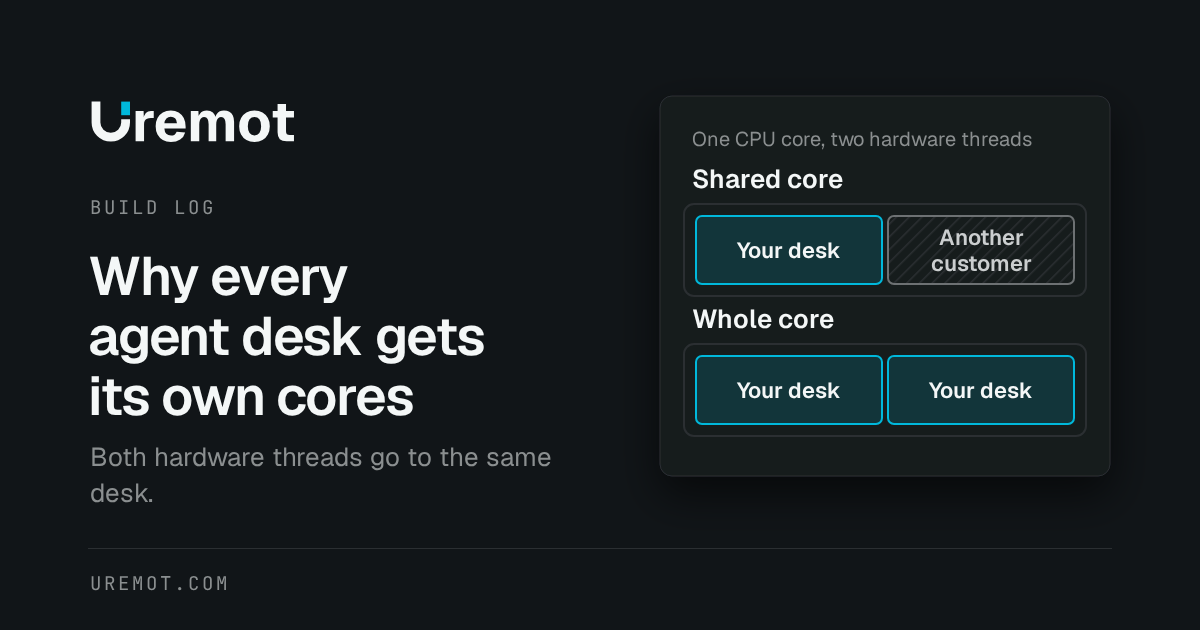
Uremot Cloud is designed for people who would rather hire an agent than host a server for it. The design gives each agent desk whole CPU cores and reserves both threads of each core for that desk while it runs.
What a desk does with a CPU#
A desk is a full Linux desktop. An agent drives a browser and other apps on it, and a video encoder streams its screen to you when you watch. Its load is uneven: the agent may wait on its model for a while, then build a project while the encoder keeps streaming.
We measured that load first. The test ran one unchanged desk image in a container and in a small VM, in four profiles: idle, idle while someone watches, a scripted browser, and a looped code build.
What shared vCPUs cost you#
Clouds sell CPU two ways. A dedicated vCPU is yours. A shared vCPU runs on a time budget.
Fly.io publishes its budget, which makes it a good example. A shared vCPU gets a baseline of 5 ms in every 80 ms, 6.25% of a CPU. Unused time builds up a burst balance, and when the balance runs out, the vCPU drops back to its baseline. A performance vCPU gets all 80 ms. Fly's model is common and fair for a web server that mostly waits. For a desk that encodes video while it compiles, we expect a drained balance to show as a stuttering stream and a slow build.
The second cost is less visible. A physical core runs two hardware threads (SMT, or Hyper-Threading), and a vCPU is usually one of them. The two threads share the core. Side-channel attacks such as Spectre variants and MDS often need that sharing to read across threads, so whoever runs on the other thread matters.
The large clouds treat this seriously:
- AWS says of EC2: "CPU cores are never simultaneously shared among customers via Simultaneous Multi-Threading (SMT)."
- Firecracker's production host guide advises: "our recommendation is to disable SMT in production scenarios that require tenant separation."
- The Linux kernel's own documentation: "The only full mitigation of cross-HT attacks is to disable Hyper Threading (HT)."
What we're building#
- A desk in its own small VM. Each desk runs in a micro-VM, not in a container that shares the host's kernel.
- Sizes in whole cores. The sizes we plan have 2, 4 and 8 vCPUs. They map to 1, 2 and 4 physical cores, both threads of each.
- No core shared between customers. While your desk runs, no other customer's desk runs on its cores, on either thread.
That is EC2's rule, applied to agent desks. It also makes the size honest: 2 vCPUs is one whole core that is yours while the desk runs, not a share of a time budget.
What it costs, and what it doesn't fix#
We expected it to cost density. With no core shared between customers, a machine can't overcommit vCPUs, so we expected fewer desks per machine and a higher cost per desk. We measured it, adding desks to one machine until a desk's stream slowed past a set line. For VM desks, the numbers went the other way: whole cores held more of them than shared cores did. Containers did fit more on shared cores. The numbers are in whole vs shared cores for desktop VMs.
Turning SMT off was the other option. On a machine with two threads per core, that leaves one thread per core. Whole cores with SMT on give both threads to the same desk. A separate shared-core test with SMT off measured streaming latency under load. It left the cost of whole-core desks with SMT off open.
Core scheduling is weaker. Linux can keep threads of different groups off each other's siblings, but its documentation says it "can mitigate some (not all) cross-HT attacks." We keep it on as a backstop under whole cores, and would rely on it alone only for a later, cheaper class, with its limits written down.
Whole cores don't close every channel. Cores on one chip still share the last-level cache and the memory bus. Owning whole cores closes the sibling-thread channel, not those. Uremot Cloud reserves cores on machines that can run desks for multiple customers. To isolate those shared resources as well, use a machine you bring.
What's next#
The first numbers are in our next post, including the lines that missed. The SMT-off results are next, followed by work on larger sizes. A shared class may come later, as a separate choice.
To run desks on a machine you bring, see Install and add a Compute.
Updated 24 November 2026 to reflect the scope of the SMT-off test.