Updated
Whole vs shared cores for desktop VMs: a cliff, not a slope
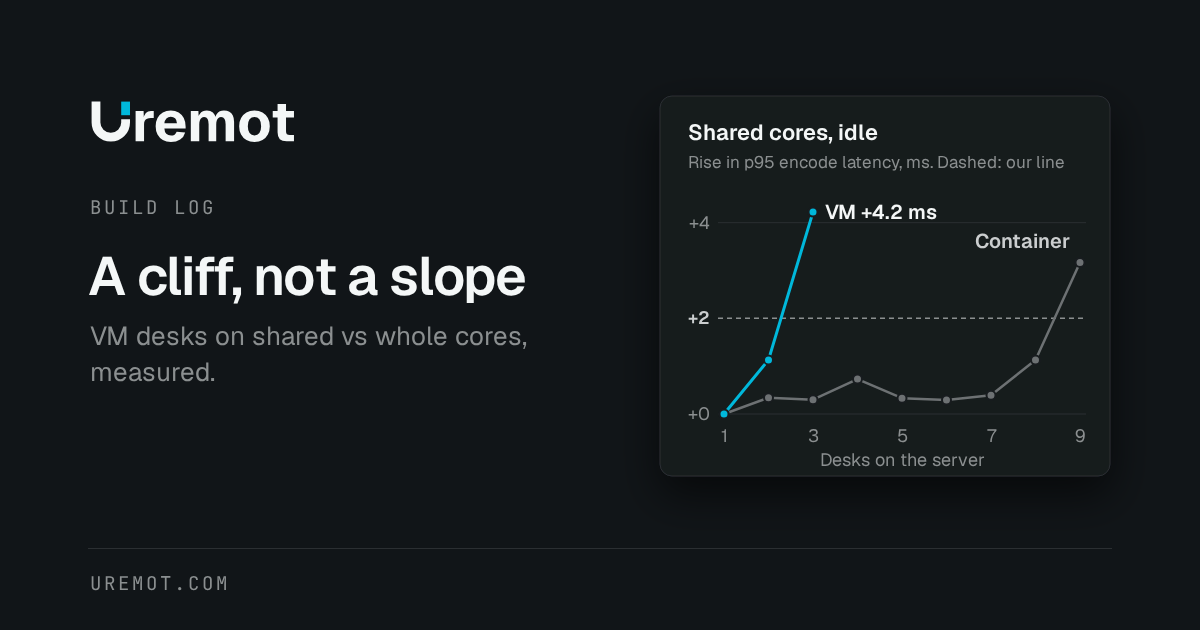
On whole cores, five cores held five VM desks. On shared cores, VM desks crossed our latency line at the second or third desk. Here are the numbers.
Uremot Cloud opens by invitation. We ran these measurements on our test bench.
In the last post we said every agent desk on Uremot Cloud will get whole CPU cores, both threads, with no other customer's desk on them, and that we'd publish what it costs, misses included. Here it is: how many desks fit when nothing is shared, what a VM per desk costs against a container, and what happens when cores are shared instead. The answer wasn't the one we expected.
The setup#
- One machine: a 6-core, 12-thread AMD Ryzen server (Zen 2), Ubuntu 26.04, Linux 7.0. One core is kept for the host's own work. The other five are for desks.
- Small desks: 2 vCPUs and 4 GB of memory, which is one whole core, both of its threads.
- Two ways to run the same desk: in its own micro-VM, as Uremot Cloud will, and in a container, the way desks run on your own machines today.
- Three loads:
- idle: a desktop at rest;
- busy: a browser scrolling a dense page full screen;
- mixed: every other desk busy.
- One desk at a time. Every desk has a viewer streaming it, and one more desk, the canary, measures how long a
frame takes from capture to encoded. We add desks until one of three lines is crossed:
- a desk's frame rate falls below 80% of what it had on its own;
- the canary's 95th-percentile latency rises by more than 20% or 2 ms, whichever is larger;
- free memory falls under 10%.
- Each canary number is the median of three runs, alone and loaded alike.
Whole cores also set a hard ceiling: five cores take five Small desks, and a sixth has nowhere to go. That isn't a line being crossed. It is the design.
The results#
| Load | Desks in VMs | Desks in containers | What stopped it |
|---|---|---|---|
| Idle | 5 | 5 | Out of whole cores |
| Mixed | 5 | 5 | Out of whole cores |
| Busy | 4 | 4 | With five busy desks, the canary's latency was past the line |
With five busy desks the canary was 2.8 ms over its time alone in VMs (8.7 to 11.5 ms) and 2.3 ms in containers (9.4 to 11.7 ms), so busy stops at four either way. That limit belongs to a fully busy machine, not to the VM.
So, on whole cores, five cores hold five desks, and the VM doesn't lower that. Only a machine where every desk is busy at once puts the canary about 2.5 ms over its time alone at five desks, in a VM or a container alike.
What the VM costs#
The VM doesn't cost desks on this machine. It costs some CPU, and it keeps its own file cache. At five desks:
| Load | Desk cores busy, VM / container | Host core busy, VM / container | Memory per desk, VM / container |
|---|---|---|---|
| Idle | 19.8% / 14.5% | 3.7% / 2.0% | 1,234 / 186 MiB |
| Mixed | 28.7% / 19.7% | 5.6% / 2.9% | 1,774 / 379 MiB |
| Busy | 35.6% / 25.9% | 7.3% / 3.9% | 2,307 / 684 MiB |
- CPU: a VM desk keeps its cores about 40% busier than the same desk in a container. With whole cores, that headroom was there anyway, and no line was crossed.
- The host's core peaks at 7.3% with five busy VMs, everything the VMs need from the host included. It is far from full.
- Memory isn't like for like. The VM's number is all the memory its desk has touched, its own file cache included. A container's file cache sits in the host's shared cache, so its number leaves that out. Each desk's 4 GB is reserved either way, so the VM's file cache never takes memory from another desk. Free memory never fell under 10%.
What missed#
- Our first frame-rate lines. The plan was to stop when a desk fell under 25 fps idle or 18 fps busy. Idle desks held 30 fps throughout. A busy, scrolling desk streams at about 8 fps even when it's alone on the machine, in a VM and in a container alike, with its CPU far from full. That is our video encoder on this kind of page on any machine without a GPU, including machines you run yourself today, and it's an open issue for our streaming. So the line became relative: a desk mustn't lose more than 20% of its own frame rate as desks are added. The absolute numbers are still recorded beside it.
- Our first latency line. A 20% rise on a 5-10 ms number sits inside one run's noise: on the first runs, a single measurement moved 20% with the machine almost idle. So each canary number became the median of three runs, and the line became 20% or 2 ms, whichever is larger.
Whole cores against shared cores#
Then we ran the same test with cores shared: desks free to float over the same ten desk threads, wherever the host's scheduler puts them.
| Load | VMs, whole cores | VMs, shared cores | Containers, whole cores | Containers, shared cores |
|---|---|---|---|---|
| Idle | 5 | 2 | 5 | 8 |
| Mixed | 5 | 2 | 5 | not in this data |
| Busy | 4 | 1 | 4 | 4 |
That is desks held before the first line was crossed. On shared cores, every VM run stopped at the canary's latency:
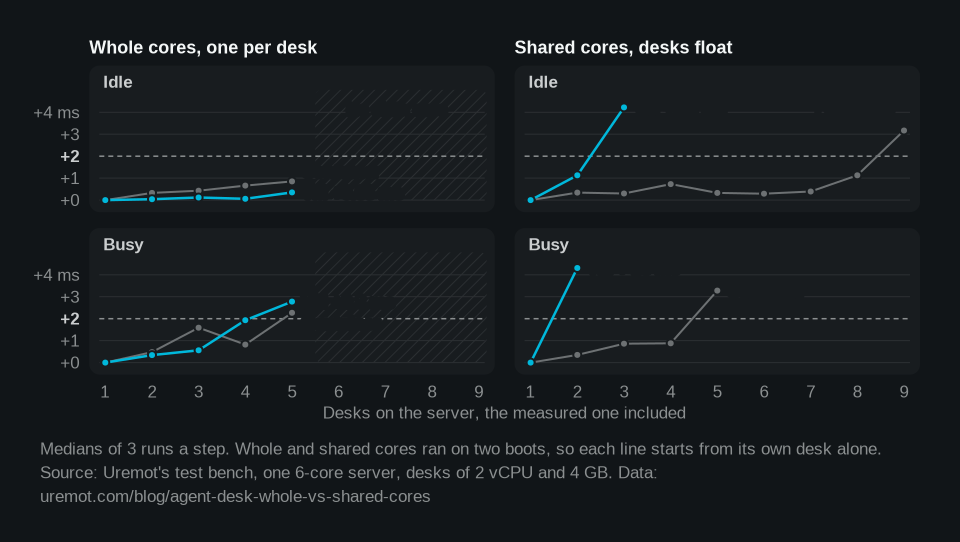
- Idle: 5.96 ms alone, 10.18 ms with the third desk.
- Busy: 7.76 ms alone, 12.07 ms with the second desk.
- Mixed: 7.80 ms alone, 13.56 ms with the third desk.
On shared cores, for VMs, it isn't a slope. It's a cliff. On whole cores, idle VM desks barely moved each other: the canary stayed within 0.35 ms of its latency alone all the way to the last core. Busy desks do climb there, step by step, by 2.3 to 2.8 ms over four added desks, in a VM and a container alike: that's a fully busy machine. On shared cores, the second idle VM desk added 1.1 ms, and the third added 3.1 ms more. The second busy desk added 4.3 ms at once. There's no gentle middle where a little sharing costs a little.
So for VMs, whole cores are also the denser choice. By our latency line, five whole cores held five idle VM desks against two on shared cores, and four busy ones against one. We expected to pay for whole cores in density. On this machine, for VMs, we didn't.
Containers behave differently. On shared cores they held eight idle desks and four busy ones. That eight isn't shared cores beating whole cores on a level field: whole cores stop at five by design, when no core is left, not at our line, and eight shared Small containers are 16 vCPUs on 10 threads, 1.6 promised for every one. Idle containers stayed within about 0.7 ms of their latency alone up to seven desks, then went over the line at the ninth. Our engineer's inference, not something we measured: a container's process wakes on the host's own scheduler, while every wake in a VM is a vCPU wake through the hypervisor, with the guest's scheduler on top of the host's. That costs little when a desk has its own cores and a lot when it waits for someone else's. This matters for machines you run yourself: desks there run in containers, and in our runs sharing cores didn't cost them desks.
Core scheduling, and what it costs#
Cloud Hypervisor, the VMM we use, turns on Linux core scheduling for every VM by default
(core_scheduling, default vm).
It keeps two different VMs off one core's two threads at the same moment, and when it can't pair a VM's own
threads, it leaves the sibling idle. On our test kernel it took effect, since turning it off changed the result.
So our shared-core runs already had this protection on.
We measured its price on idle desks. With it on, two VMs fit before the line. With it off, three did, and at three desks the canary read 10.18 ms with it and 7.82 ms without. On shared cores it costs about 2.4 ms there. It also isn't a full answer: the kernel's own documentation says core scheduling "can mitigate some (not all) cross-HT attacks" (kernel docs).
With whole cores, both threads of a core belong to one desk, so it never has to hold a sibling idle. The whole-core runs above had it on, and VMs still matched containers there.
Reading these numbers#
- The two layouts ran on two boots of the same server, each with its own host settings. A desk alone read about 7.6 ms on one and 6.0 ms on the other. So compare milliseconds only within one layout. Each run's line, and the chart, are against that run's own desk alone.
- Desks held is a count by our line, not a hard limit: the next desk on shared cores still runs. Its stream just gets slower than our line allows.
- The data: every run's per-step numbers are in one CSV, with what each column means. The three canary runs behind each number are in a second CSV.
- Three runs a point is few. On shared cores the three were up to 6.4 ms apart at one step, and every crossing there was two runs of three, where both crossings on whole cores were all three. It cuts the other way too: on whole cores the fourth busy VM desk held by 0.07 ms, 10.66 ms against a line of 10.73 ms, with one of its three runs over the line. The "four busy ones against one" above rests on that hold.
- One machine, one size (Small), one encoder. The container mixed run on shared cores isn't in this data.
What's next#
We have since run the same test with SMT off; those numbers are not checked and published yet. Larger sizes come next. Other machines may come out differently, and we'll post those numbers too, including the ones that miss.
Updated 19 November 2026: names the machine, and says how far apart the three runs behind a number were.