What happened to desktop VM density with SMT off
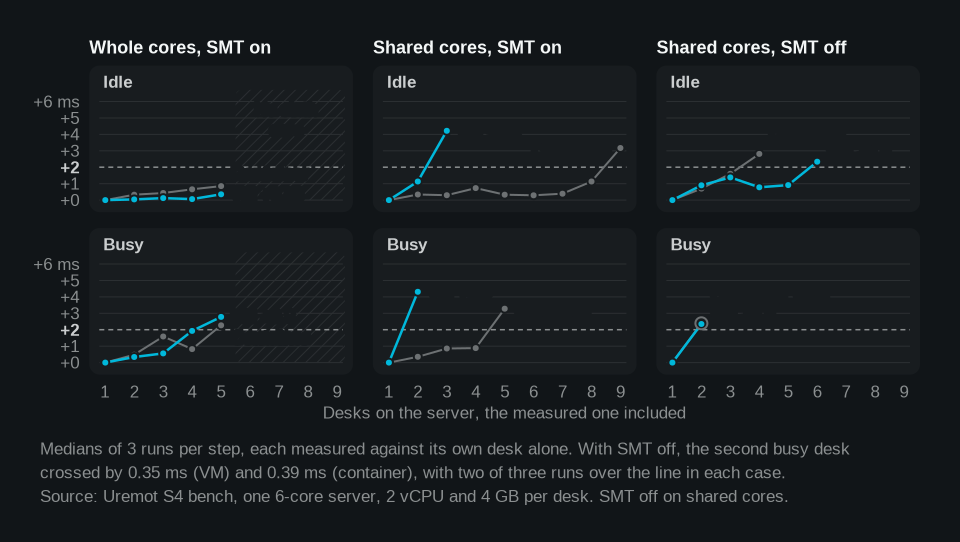
On one test machine with SMT off, a second busy desk crossed our latency line in both a VM and a container. All six crossings were within 1 ms of the line.
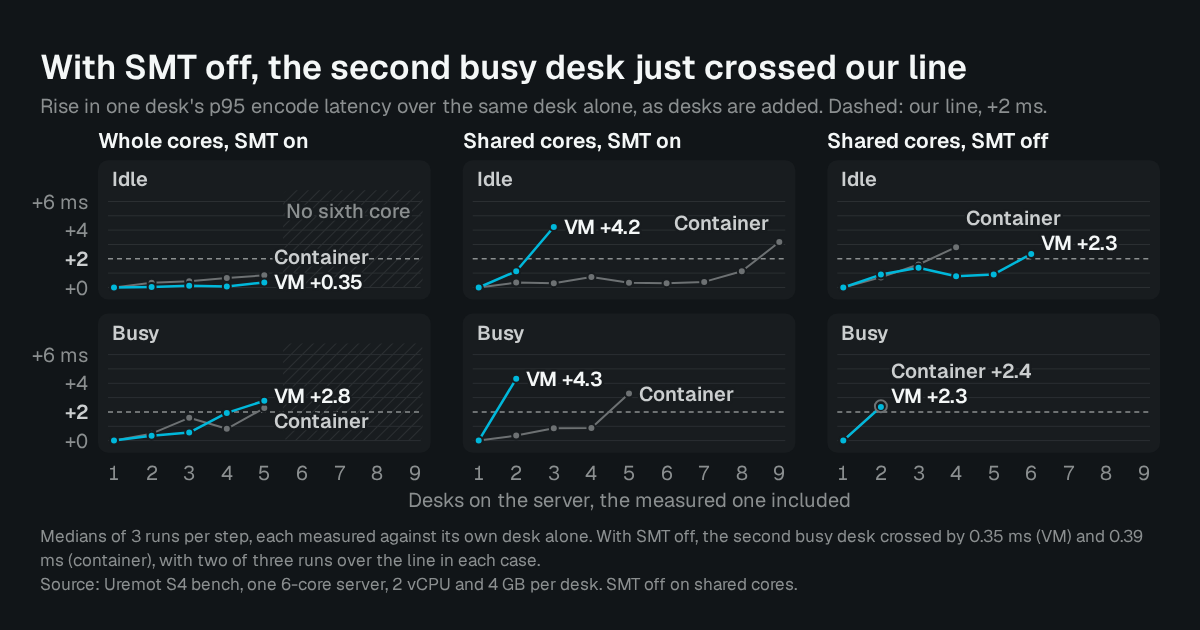
In our earlier test, five whole CPU cores held five idle desktop VMs. Sharing those cores gave a different result. We went back to the same test machine and ran the shared-core experiment with simultaneous multithreading (SMT) off. One thread per core was available. The earlier test
The second busy desk crossed our streaming-latency line in both a VM and a container. Five idle VMs held by the median, and individual runs sometimes crossed earlier. These are results from one machine and workload.
The setup#
We kept one of the machine's six cores for the host and shared the other five threads among the desks. Each desk had two vCPUs and 4 GB of memory. We tested micro-VMs and containers with the same idle, busy and mixed loads. A busy desktop scrolled a dense page. In the mixed runs, every other desktop was busy.
We added desks one at a time and measured the first desk's p95 capture-to-encoded latency. Each point is the median of three runs. The stop line was the larger of 20% or 2 ms above that desk's latency alone. In these six tests, the line was 2 ms. All six ended when latency crossed it.
What fit by that line#
| Layout | VM idle | VM mixed | VM busy | Container idle | Container mixed | Container busy |
|---|---|---|---|---|---|---|
| Whole cores, SMT on | 5 | 5 | 4 | 5 | 5 | 4 |
| Shared cores, SMT on | 2 | 2 | 1 | 8 | No result | 4 |
| Shared cores, SMT off | 5 | 2 | 1 | 3 | 3 | 1 |
The whole-core idle and mixed runs ended when all five cores were assigned. The other counts show how many desks held before the next one crossed the latency line. The experiment with SMT off used shared cores throughout.
| Run with SMT off | Desk alone | Stop line | Last count within the line | First count over | By |
|---|---|---|---|---|---|
| VMs, idle | 6.00 ms | 8.00 ms | 5 | 6 | 0.34 ms |
| VMs, mixed | 7.76 ms | 9.76 ms | 2 | 3 | 0.32 ms |
| VMs, busy | 7.68 ms | 9.68 ms | 1 | 2 | 0.35 ms |
| Containers, idle | 4.49 ms | 6.49 ms | 3 | 4 | 0.81 ms |
| Containers, mixed | 5.70 ms | 7.70 ms | 3 | 4 | 0.17 ms |
| Containers, busy | 5.30 ms | 7.30 ms | 1 | 2 | 0.39 ms |
How much weight to put on the counts#
Every crossing was within 1 ms of its line. Five of the six crossings had two runs out of three above the line. The mixed VM crossing had all three above it. Seven of the nine loaded steps that held had one run above the line. At five idle VM desks, the three runs were 6.9 ms apart.
With two busy containers, the median crossed by 0.39 ms. In the mixed container run, the median with three desks, two busy and one idle, stayed within the line. The smaller margins can move with another run.
Use each run's own baseline when reading the milliseconds. These counts describe one machine, desk size, encoder and set of workloads. The test gives a comparison at our cutoff and leaves whole cores with SMT off for another measurement.