What a VM per agent desk costs us, measured
Uremot Cloud is designed around a micro-VM for each agent desk. We measured encode latency, CPU, memory and build time against a container on one Small desk.
Uremot Cloud opens by invitation. We ran these measurements on our test bench.
On Uremot Cloud, every agent desk will run in its own micro-VM, with its own kernel, rather than in a container that shares the host's kernel with other customers' desks. We chose that for isolation, before we had measured anything. A VM isn't free, so we measured the price. Here it is.
The setup#
- The same desk both ways: a Small desk (2 vCPUs, 4 GB) running the same image, once in a Cloud Hypervisor micro-VM and once in a container, on the same server.
- The stream: the desk encodes its own screen at 1280×1024 with openh264, the CPU encoder, and we time each frame from capture to encoded. That's the encoder's latency, not the whole trip to your screen.
- Two loads: an idle desktop, and a moving one.
- Five runs of 20 seconds each, and we report the median of the runs' p50 and p95. Every run's numbers are in one CSV, with what each column means.
Encode latency: the one real cost#
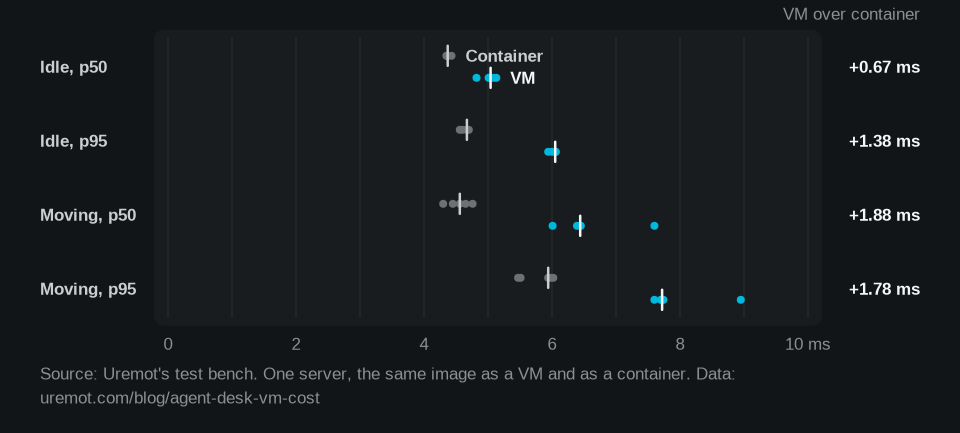
| Idle, p50 / p95 | Moving, p50 / p95 | Frame rate | Host CPU | |
|---|---|---|---|---|
| Container | 4.37 / 4.67 ms | 4.56 / 5.94 ms | 30 fps | 32.3% of a core |
| VM | 5.04 / 6.05 ms | 6.44 / 7.72 ms | 30 fps | 31.4% of a core |
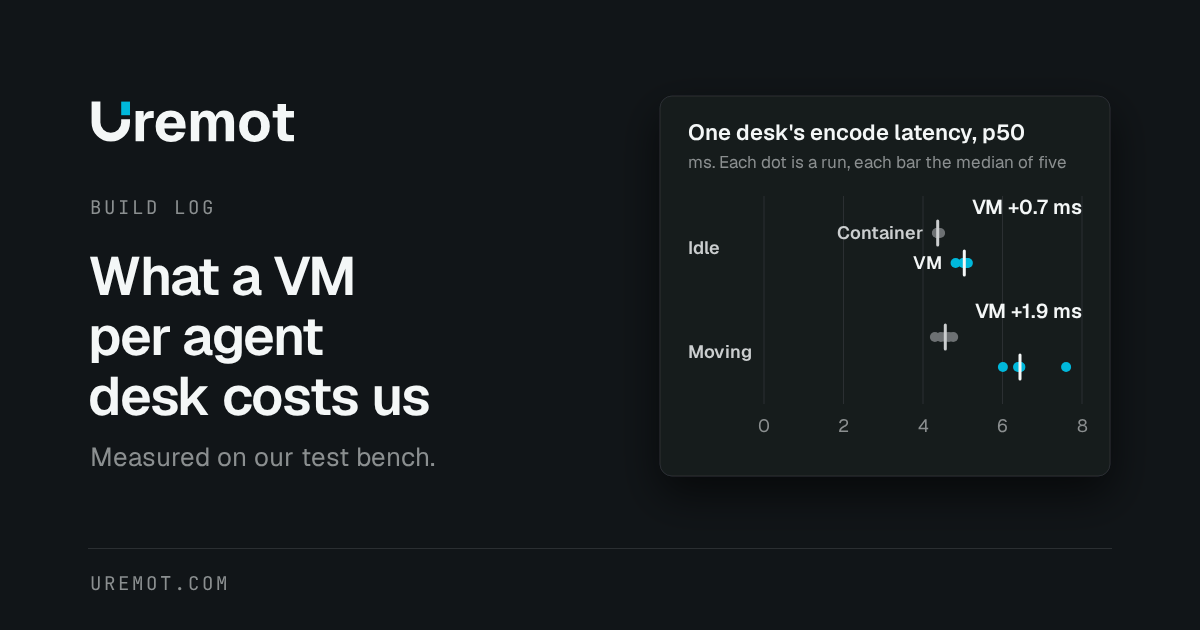
The VM adds 0.7 ms at p50 when idle, and 1.9 ms when the screen moves. Both hold 30 fps, and the encoder uses the same CPU either way. At 30 fps a frame is due every 33 ms, so 1.9 ms is under a fifteenth of that budget (our arithmetic).
What missed: our first line for this test was "within 10% of the container", and the VM misses it, by about 15% idle and 40% moving. Against the second line we'd set, within 2 ms of the container, it passes, by a tenth of a millisecond when moving. That's close, and we're watching it.
Where the gap comes from, and the knobs that didn't help#
A vCPU that has nothing to do halts, and waking it up goes through the hypervisor. Linux has two well-known ways to make that wake cheaper, so we tried both.
- Halt-polling in the guest (
cpuidle-haltpoll): the guest spins briefly before it halts, hoping the next bit of work arrives first. With our hypervisor the guest didn't load it on its own. Our inference: the hypervisor doesn't offer the guest the paravirtual feature it looks for. Forced on, it loaded, and nothing moved: every number stayed within noise. idle=poll, as a lower bound: the guest never halts at all. The idle gap closed to within 10% (4.65 against 4.37 ms), and the moving one shrank to 1.3 ms. It cost two whole cores of host CPU for one desk (200%), so it shows where the time goes, not a setting anyone should run.
So roughly 0.4 ms of the idle gap is waking a vCPU (our inference from idle=poll). The rest of the moving gap is
somewhere we haven't measured yet. One possibility is that the remaining delay comes from VM exits during screen
capture and shared-memory access.
Since we measured: the gap is the vCPU count#
After the runs above, two more pointed away from that guess:
- A different guest kernel changed nothing. We booted the VM with the guest kernel Kata Containers ships, built with a different preemption and timer setup: 5.02 ms idle at p50, against 5.04.
- A third vCPU closed the gap. At 3 vCPUs the VM came within 4% of the container: 3.7% slower idle, 2.4% faster moving.
Our reading, which is inference: a container limited to two CPUs gets two CPUs' worth of time spread over every thread of the machine, while a VM with two vCPUs has exactly two threads, and the encoder queues behind the desk's other work.
On the layout we'll actually run, the desk's two vCPUs are one whole core's two hardware threads. There both were slower, and the VM failed our 2 ms line on a moving screen. Encode latency in ms, p50 / p95:
| Desk on one whole core | Idle | Moving |
|---|---|---|
| Container | 7.50 / 7.67 | 8.17 / 9.38 |
| VM, 2 vCPUs | 8.12 / 11.57 | 10.89 / 15.86 |
VM, encoder at nice -5 |
6.40 / 7.13 | 8.05 / 9.35 |
A third vCPU would cost a second core, so we're testing a raised priority for the display instead: in our runs, the
benchmark's encoder at nice -5 brought the VM back to the container's numbers (table above). Timed
from our streamer's encoder to the frame decoded in a viewer, at 1920×1080 on this layout, the VM was already within
0.5 ms of the container at p50 and 1.0 ms at p95, so this keeps the encode line rather than fixing something a
person would see.
We haven't shipped a priority rule yet. We still need to measure it under a busy desk. We don't know yet why both are slower on a whole core than spread over the machine.
CPU: no difference on one desk#
| Profile | CPU cores used, container | CPU cores used, VM |
|---|---|---|
| Idle | 0.031 | 0.044 |
| Idle, with a viewer | 0.285 | 0.294 |
| A browser scrolling, with a viewer | 0.543 | 0.540 |
| A software build | 1.997 | 1.989 |
The same desk does the same work for the same CPU. The build (ripgrep, -j2, looped about 20 times) took
27.1 s in the VM and 28.6 s in the container, at the median. We haven't dug into why the VM came out ahead.
That is one desk, spread over the machine. On whole cores, our density test found a VM desk keeps its cores about 40% busier than a container, inside cores it has to itself.
Memory: the VM keeps its own cache#
| Profile | Container, memory (of it, the process's own) | VM, guest memory |
|---|---|---|
| Idle | 418 MiB (72) | 1,152 MiB |
| Idle, with a viewer | 117 MiB (95) | 1,172 MiB |
| A browser scrolling, with a viewer | 1,000 MiB (583) | 2,248 MiB |
| A software build | 1,433 MiB (293) | 2,914 MiB |
These two columns don't measure the same thing:
- A VM holds every page its guest has touched, and a guest touches a lot just booting: most of the idle VM's 1,152 MiB is the guest's own file cache from starting up. After a build, the guest held 1.9 GiB of cache it may never read again.
- A container's file cache lives in the host's shared cache, and it's charged to whichever container read a file first. The first container on a cold host carries the image's files (328 MiB of the idle row); the next one shares them for almost nothing (11 MiB). So a container's stable number is its own process memory, in brackets.
Every Small desk has its 4 GB reserved either way, so the VM's cache never takes memory from another desk. It does mean a VM uses the memory it's given, where a container often doesn't.
We tried to give some back. A virtio-balloon with free page reporting lets a guest hand freed pages to the host. It made no real difference: the desk's memory on the host stayed within 3% of the plain VM in every profile, a little lower in two and a little higher in two. Our inference from the guest's own counters: the pages a guest touched are either in use or in its page cache, and cache isn't free, so there's nothing to report. The lever is the guest's cache itself, which we haven't pulled yet.
On the bench, the host also cached the VM's disk reads, on top of the guest's own cache: about 1.35 GiB during the build. On our hosts that cache is off: each desk's disks are opened with direct I/O, so the host's page cache, which is shared between desks, never holds them.
The VMM's own overhead, outside the guest, is about 6.3 MiB per desk.
The bill#
For a kernel of its own, a desk on Uremot Cloud pays, on this bench:
- 0.7 to 1.9 ms of encode latency at p50, spread over the machine; on a whole core, about the same as a container with the encoder's priority raised, which we haven't shipped;
- no extra CPU for one desk spread over the machine, and a build that ran slightly faster; on whole cores, cores about 40% busier, which the desk has to itself anyway;
- its own file cache, inside memory that's reserved for it anyway;
- and, from our density test, no desks on whole cores.
We think that's a fair price for not sharing a kernel with other customers' desks. The numbers are one server, one desk size and one encoder. We'll post the rest as we measure it, the misses included.